Showing posts with label writing resources. Show all posts

25 Jun 2014

Important Notice: Storyslingers' blog has moved!

Over the last few months a number of the Storyslingers who post to this blog have had issues with signing into Blogger or browser crashes while using it. For this reason, we have relocated to Wordpress which we are already finding far more reliable and easier to use. As it stands, this blog will no longer be updated.

Please update your bookmarks and links to point to our new home on the web:


And if you're a member of Wordpress or have been considering starting a blog there, please do come over and connect!

- Storyslingers

21 Jun 2014

The (Vast) Difference Between a Critique and an Edit

Usually, when a writer has finished a story or taken a story as far as they can, they send them out to critique groups or beta readers for feedback. As the author, it's difficult disconnecting from a story's headspace, and that makes it tricky to judge if everything is working. This is where critique groups and betas are invaluable: the fresh eye, the new perspective, the telling reactions. These all help author see where a story might still need work.

But there's a big difference between a critique and an edit, and sometimes authors get back one when they really need the other. I'm going to talk about why, break down each one, and suggest things writers should do when approaching someone for feedback.

Critique:

A critique is an evaluation. It's a review where you look at the bigger picture and consider things like pacing, clarity, character motivation, character arcs, plot and plot holes, weak dialogue, unnecessary exposition, theme and motif. This is where you think about whether or not every chapter, every scene, every paragraph advances the plot. You ask if all the characters are pulling their weight. You ask what the writer is trying to get across. Think: bigger picture, overall story.

Edit:

An edit focuses more on grammar, style, and punctuation. It picks apart paragraphs and sentences and looks for inconsistencies, repetitions, misused words, typos and spelling errors, awkward sentence structure, etc. It can expand to include suggestions on characters, dialogue, pace and plot, but these are generally smaller observations, on a paragraph by paragraph (or line by line) level. Think: details, fine tuning.

When you send stories out for feedback, be clear about the following:

1) How 'finished' is your story. It's no good getting line edits on a first draft--it wastes everyone's time. Ideally, you don't want line edits until you've fixed the plot and characters. Plot and characters come first, and they should be analysed in a critique. Often revision is required, which can lead to whole chunks of a story being rewritten. How awkward when you have to explain to a beta reader who just spent two hours line editing your work that you've had to rewrite the entire story from scratch.

2) Be clear about what type of feedback you need. Specify the elements of a critique if your reader doesn't know the difference. Ask questions (put them at the end of the story so as not to influence the reader before they start), and get them to write down their reactions as they read. Did their attention wander at any point, and if so, when? Were the character motivations clear and believable? Did the ending satisfy and tie in, at least a little, with the start? Was anything confusing? If the reader has never critiqued before, these questions will help guide them through it.

Writers become better writers much quicker through writing, reading, and critiquing. Editing will help teach you when to use commas instead of semi-colons, but it won't teach you how to develop an engaging character with clear, compelling motivations, or sharpen your use of metaphor or motif, or just tell a damn good story. Semi-colons generally don't sell fiction. Good stories do.

(Not, I want to add, that there's anything wrong with a semi-colon! I ♥︎ them.)

If you're a fiction writer, start critiquing. Do it every week. If you can't find a fellow author to crit, then pull an anthology off a shelf and practise with that.

Here are some other excellent resources on writing critiques:

How to Critique Fiction, by Victory Crayne.

Nuts and Bolts of Critiquing, by Tina Morgan, posted at Fiction Factor.

15 Questions for Your Beta Readers, by editor and author Jodie Renner, posted at Kill Zone.

30 May 2014

On Countersinking: Showing and Then Telling

This is inspired by Turkey City Lexicon - A Primer for SF Workshops. It's worth checking out the full article because it highlights some of the common clichés and pitfalls that can clog up a story. The article was written with sci-fi in mind, although a lot of their points relate to all fiction genres.

The one I'm focusing on is countersinking. This one makes me grin because I used to do it a lot in my early writing. A few years ago, me and a friend set about workshopping our earliest pieces to see what we could learn, and to track our improvements. The workshops were a riot—seeing ourselves as young, bouncy authors, full of excitement and dreadful clichés, lacking finesse and attention to detail but having so much fun writing and developing our styles. It's a bit like travelling back in time and spending an afternoon with the kid version of yourself, entertaining and not a little eye-opening. I'm way more conscious of countersinking nowadays and rarely find it slipping into my prose, but I do falter occasionally, and often stumble upon it when reading other people's work.
"You have to get out of here," he said, urging her to leave.
And here is what's happening:
A form of expositional redundancy in which the action clearly implied in dialogue is made explicit.
Or as I like to call it, "showing and then telling". It's obvious from the dialogue that somebody is urging someone else to leave, so the explanation urging her to leave is redundant.

Newer authors tend to do this due to a lack of confidence, but even pro authors are prone to do it too. I'm quite sensitive to countersinking; it slows down a story, reads clunky, and makes the writing feel loose and flabby. When doing a round of edits that focus on dialogue, I'm always on the lookout for sneaky countersinks. And if I find any? I kill them.

It's strange how writing peeves can bring up so many nostalgic feelings. :) 

24 May 2014

Choosing Character Names: Fun, or a Total Nightmare?

Character names can be tricky fishes. Occasionally you'll think you've got the perfect name for your protagonist, only to get halfway through a story and realise that the name no longer suits them. Names can be used to stunning effect, evoking images, sounds, and even themes. They can hold meaning, both hidden and obvious, or they can be so generic that they don't stand out at all.

But it's a fine line between picking a name you want, picking a name that fits the character, and picking something that's not going to jar or distract readers.

We're often advised to avoid names that are too out there, absurd or overly complex, and just plain impossible to pronounce. But occasionally a story will call for the wacky. A good example of this is Douglas Adams's Hitchhiker's Guide to the Galaxy, where you can find names like Zaphod Beeblebrox and Slartibartfast. And that's OK, because it's a space comedy whose ethos is the pointlessness of trying to make an impact in an unfathomable universe--absurd names are the least of these characters' problems. The thing is, those names probably wouldn't work so well in a contemporary romance or a period drama like Downton Abbey.

And then there are names that try just a little too hard to make the character sound cool or edgy. If you're writing an action thriller, calling your ex-marine protagonist Rock Stoneblast might draw more snickers than anything. Actually, a while back Sky compiled a list of 20 Mental Movie Monikers, worth checking out for the lols.

Sci-fi and fantasy fall victim to impossible character and place names more often than most other genres. This is where you get your L'kazyx'hiqxues from planet Xzerquee'h'ex or somesuch (which is probably in the Pzzy'awxze'a galaxy). These monstrosities can be enough to make a reader quit early on. There's also the issue of people who read out loud to themselves or read stories to other people, and don't forget audiobooks.

When I pick names for my characters, the first thing I do is check their meanings on Behind the Name, just to make sure I'm not making any unintentional faux pas. The nerd in me quite likes it when an author gets clever with name meanings. You never know, there might be a reader who looks it up and is surprised to find the meaning has a connection to the characters' backstory, attitudes, etc.

You also need to be mindful of when your story is set and which names were popular at the time. Putting a Beyoncé in 17th Century rural England probably won't fly with the history buffs. ;)

There are tons of excellent sources for names, if you're really stuck. With a little patience, you can generally find good stuff in the phone book, movie or TV show credits, even graveyards (creepy, I know, but sometimes you have to get creative!). And there are the online venues Baby Names, The Internet Surname Database, Random Name Generator, as well as Behind the Name (linked above). And a silly one, Name Generator Fun.

So how do you go about naming your characters? Do they walk into your head fully formed with a name, or do you begin with a name and build the character around it? Do you struggle to find fitting names for your chars? Have you encountered any memorable names from books/TV/movies that you want to share? I'd love to hear them!

(This entry was originally written for and posted to the Get Your Words Out community on LiveJournal.)

8 Dec 2013

Developing Characters, Part II

This is a follow-up post to Developing Characters, Part I.

I'd like to go into more depth on character voice and how to develop it. I can only speak for the way I do it; some of these methods might not work for others.

Years ago, when I was trying to strengthen my character voices, I would watch/read/listen to stories that had solid, distinctive characters and take note of the rhythms and phrases those characters used—not only in their speech, but also in their internal monologues. There are subtle differences between "Please make me a cup of tea" and "So are you gonna make me some tea, or am I gonna have to do it myself?" — the latter is wordier, yes, but the voice is more distinctive. Voice (dialogue and thoughts) doesn't need to be spectacular in early drafts, but how characters talk and think should be considered at some stage during editing.

Here's a trick to see how distinctive characters are: take a scene or chapter where there's interaction, and select only the dialogue. Paste the dialogue into a fresh document without any speech tags, names, or other identifying descriptions. Read through it, or have someone else read it, and check where the voices merge or sound too similar. Is there confusion as to who's speaking? If yes, either try loosening up one of the voices or make it more formal. Give one of the characters a verbal tick (like the tendency to say 'you know?' at the end of some of their sentences), or a light accent (though use accent carefully) and then re-read it. Better? It should be.

Another way of tempting out voice is figuring out how your characters feel about what's happening. This will inform their attitudes and moods, and consequently what they're saying and how they say it. Have them react, let them feel, give them passion and the ability to speak up. Let them tell lies. We all do it. An angry character might speak faster in short, snappy sentences, and they might swear or exaggerate, whereas someone speaking calmly and formally might use longer, more complex sentences and have a precise thought process.

Listen to conversations on the street, in your workplace and at home. I've mined real people I know for turns of phrase and verbal ticks. But also remember to look for people who are more guarded, who speak neutrally and try to maintain status quo—often you can have fun with a conflicting internal dialogue and thought.

I mentioned in the previous post shoving characters out of their comfort zones, and this also goes for shoving them at other characters. Bring in the type of person they despise, or someone they're intimidated by, or someone they're attracted to, and see how it changes what they say and how they speak. Character/character interaction drives plot and gives scenes energy. If everybody gets along all the time, dialogue can become lifeless. Even if your characters are friends, have them disagree regularly, or give them a rivalry that you can mine for little tensions.

IMO, most importantly, you'll only get to know your characters well by writing them. Outline and do questionnaires and mind-map them, too, but they have to act and react to really shine.

5 Dec 2013

Developing Characters, Part I

A well-rounded character has both good and bad traits, much like we do. A character doesn't have to be particularly likeable, either, but readers must be able to empathise with them, at least somewhat. I think this is what readers connect with (and how to keep them reading)—they see a little of themselves or someone they know in a character. Yep, even in the bad guys.

When I'm trying to find a character's unique voice, I always use their surroundings to influence how they would speak and act. I try to consider the time period, the social background, even the genre I'm writing—all these things will (and should!) effect voice. Saying that, I also think we often worry too much about finding a voice before we've even started, when all we really need to do is write and uncover it along the way. (Of course, it's always nice if a character comes along with a strong voice already. :))

And if they still refuse to cooperate, you can always throw them into random and difficult situations that take place outside your main story. Write some drabbles or flash pieces and toss your characters into a crisis, or bring someone in from their past and make them deal with it. As their actions and decisions take place, you should get to know them better and it can help figure out what makes them tick. (Interviews and character questionnaires are also good for character-building. You can find some examples here and there's a handy tag on Tumblr here.)

Also, the naming process often does my head in and sucks up hours of time. But! Three great resources I've used in the past for finding names (and name origins and meanings) are Behind the Name, Baby Names, and The Surname Database. I nerd out when a character's name has a hidden meaning.

Research is good, but ultimately I find the best way of developing my characters is to just write them—in their own stories, in side-stories, and you can even shove them into other people's stories.

19 Sept 2013

New Collaborative Geofiction website

Johannes Bouchain of Urban Geofiction and his colleague Thilo Stapff have set up a new geofiction community like no other. This is a collaborative geofiction experiment that welcomes cartographers to add to the map.


Using the tools of the Openstreetmap project - http://www.openstreetmap.org -, Opengeofiction offers, for everyone who would like to participate, the possibility to contribute to mapping a fictional planet. Interested? Then
1. Create your account http://opengeofiction.net/user/new (you'll get an e-mail when your account has been activated, it may take a little while)
2. Choose a free (green) area from the overview map http://opengeofiction.net/about#overview-map (please send an e-mail to info@opengeofiction.net and mention the area you've chosen)
3. Start mapping by using the tools available (http://wiki.openstreetmap.org/wiki/Editors). If you don't have any experience yet, please tell the Opengeofiction team atinfo@opengeofiction.net and they'll try to help you as much as possible.

Find more information about the project and about other ways to participate here:
http://opengeofiction.net/about

Examples for what it can look like:
http://opengeofiction.net/?lat=45.22&lon=-21.28&zoom=8&layers=M (Roantra)
http://opengeofiction.net/?lat=47.809&lon=-8.902&zoom=9&layers=M (south of Kalm/north of Sathria, "under construction")

You already have a fictional country and/or city that you would like to place on the Opengeofiction planet? That's wonderful! The free (green) areas at the overview maphttp://opengeofiction.net/about#overview-map can still be changed a little bit, so that your imaginary country hopefully will find its place in one of the continents. Maybe you find an area that already has almost the same form as your fictional country (and is also located in the right latitude, so that the climate is like you imagine it for your country).

9 Dec 2012

Mind-Mapping for Fiction Writers

Today I'd like to talk about mind maps—what they are, how to use them, and where to get them—as a way of brainstorming, solving problems, keeping track of your events and timelines, and generating new ideas.

Sometimes stories are straightforward: you begin with your basic idea or outline, and then you sit down and write it from start to finish. But not all stories are that easy-going. Quite often you find they grow and become complex, unruly things, and before you know it you're buried under a mountain of notes and plans, maps and research—and that's before you've even tried to structure your plot or study your characters in depth.

This is where mind maps could come in handy.

I'm fairly new to mind maps, but so far I've found them helpful for keeping my novel timeline in order. They're also an excellent "quick-reference" if you're looking for a specific detail and you don't have time to wade through page after page of notes.

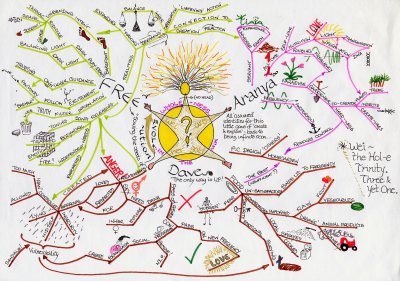
What is a mind map? From Wikipedia - A diagram used to visually outline information.

How do I use a mind map? You start with a central theme or idea, usually placed at the centre of your map/page. This could be anything from a single word prompt to a phrase or topic, problem, character or concept. From there, you create sub-nodes and attach anything associated with the central theme. These sub-nodes grow outwards, generating more and more sub-themes and ideas, very much like a spider diagram. The best way to understand how a mind map works is to see one in action. Take a look at this hand-drawn mind map and this computer generated map (both images from Wikipedia).

How to make a mind map: You can create easy, free mind maps using paper and coloured pens or pencils (see example map above). But if hand-drawing isn't your preference, there are also a number of programs available for the computer—some free and some paid.

Free Mind – Free Mind is a Java-based software that is free to download and use. They have a helpful website that provides instructions on installing and running the program. Works on PC and Mac.

Simple Mind – A simple, easy to use program. This is also a Mac app, but I'm linking to the desktop version as you can use it on a PC as well. You can only download a trial for free; you'll need to buy the full version if you want to keep using it after 30 days.

Bubble.us – I've not tried this one, but it looks like it could be useful. You create your mind map directly in your browser. You can print it out, or download it to your computer when you're done.

Mindomo – This is a paid program. The website states: Human thought is characterized by expansion in multiple directions.  As a mind map software, Mindomo is a perfect match to work the way your brain does reflecting your thoughts.

MindMeister – This mind-mapping tool allows you to share your mind maps with others and collaborate easily. There is a free trial, though it should be noted that you have to pay a monthly subscription for the full program.

There's also a list of (rather pricey) paid mind map programs for Mac here, and a list of freeware programs for Mac here.

And there's a list of free mind map programs for PC here.

27 Aug 2012

First Lines Challenge

At the last Storyslingers meeting, I set everyone a challenge to come up with up to five opening sentences to stories they've never written. These sentences are currently being compiled into a masterlist of first line prompts. You can find the list on our prompts page. Definitely worth checking out if you're looking for inspiration, or you just want to oil the writing hinges.

There are all sorts of opening sentences: fun, frightening, mysterious, serious, literary, tongue-in-cheek. Here are a few to wet your whistle:
  • The suddenly ability of apples to fall upwards and for water to boil as it cooled should have perplexed me enormously, but instead it left me slightly aroused.
  • Roland Boyle had been digging for spare change, but he didn't expect to find a razor blade hidden within his pocket lint.
  • The floorboards creaked and the shutters flapped like trapped souls against the windows; the house had been waiting for me.
  • The six members of the village committee stood staring at the bloodied carcass lying in front of them.
Feel free to send us your opening sentences (either post them in the comments to this entry, or email them to joliverdesigns(at)gmail(dot)com. There are two rules: the sentence is written by you, and it has not been used in a story already.

22 Aug 2012

About Literary Agents

There have been a few misconceptions about agents--what they are, what they do, whether they cost or not, how it all works, etc--so I thought it would be good to briefly clarify a few points in case anyone is still unsure.

The number one factor you should be mindful of when searching for an agent is this:

You should not pay agents to represent you / look at your work.
If an agent asks you to pay them up front to read your manuscript or represent you,
run away. Quickly.

The agent gets paid when you sell your book to a publisher. An agent will take a cut out of your royalties that the publisher pays you. Usually this is around 15% - 20% (it can vary, depending where in the world you are and who you sign with).

Again, be extremely wary of agents that ask for payment up front. They could be frauds. If you're not sure, there are a number of excellent websites that list known fraud agencies. Writer Beware is probably the best.

So what are agents and what do they do? Jane Friedman says it clearly and concisely on her website:

In today's market, probably 80 percent of books that the New York publishing houses acquire are sold to them by agents. Agents are experts in the publishing industry. They have inside contacts with specific editors and know better than writers what editor or publisher would be most likely to buy a particular work. 

Perhaps most important, agents negotiate the best deal for you, ensure you are paid accurately and fairly, and run interference when necessary between you and the publisher.

It's also advisable to ask an agent who else they represent. Or, you can research this online. Agents unwilling to mention any of their authors by name or any recent sales could be dodgy.

Be wary of agents who refer you to an editing service you have to pay for. As sff.net says:

There is, however, a common scam where the agent recommends an editorial service. There's a good chance the service is paying the agent a kickback to make that recommendation.

Also be watchful for "vanity presses" who expect you to pay them to publish you.

It should be noted that you do not necessarily need an agent. It depends on what publishing route you prefer to take, as well as the type of work you're trying to sell. Not everybody wants an agent or a traditional publisher, and there are other options available, such as self-publishing and e-publishing.

14 Dec 2011

How Social Networking Can Help Establish Authors

Good afternoon, Storyslingers readers! Today we have a blog for you about social networking and how it can benefit new or up-coming authors. As always, discussions are welcome, and if you have any questions or comments about this post, feel free to drop them below.

The Importance of Networking

Reaching out to your readers and potential readers both offline and online is majorly important if you want to draw in the crowds. With an ever-widening market for e-books as well as print books, it's easy to sink beneath the ocean of other writers struggling to be seen and heard, and most importantly—read. A good place to start building your author presence is online, particularly if you're a busy writer or can't afford to attend book and writing conventions.

To someone unused to social networking, the sheer amount of websites, blogs, and forums can seem daunting. The key thing to remember is you really only need to pick one or two (or a handful, depending on your free time) to visit regularly, at least at first. It's about cultivating a presence in your niche, not spreading yourself too thin. When you're relatively unknown, it might be tempting to create accounts on multiple websites, but realistically, it'll be difficult keeping on top of everything.

Choosing the right social networking sites for you is a little bit down to personal preference, although there are a few biggies that you should be aware of. These are generally the best places to create accounts due to their immeasurable popularity and how current they are. Facebook is one. Twitter another. I'm sure you've heard of them, even if you haven't visited them.

There are also a number of busy forums dedicated to writing and reading. An excellent example is Litopia Writers' Colony, a sprawling website that hosts discussion boards, podcasts and radio shows, interviews, reviews—just about everything a reader or writer could hope for. For similar sites, please refer to the links below.

Getting Started

Again, social networking doesn't have to be a stressful endeavour. You can put in as much effort as you want, but bear in mind, you'll probably get out about as much as you put in, sometimes less, which is why it's advisable to log in at least once a week and drop a note to update friends and connections on what you're up to. Take a moment to check other people's statuses, too, and comment on anything that catches your eye. As nice as it is to have a ready audience waiting to hear from you, there needs to be some give as well. If you rarely post and never comment on anyone else's blog or page, you may find people will stop commenting on yours. The secret is in the name: social networking. Give and take. Communication. These are the things you'll need to build up a solid network—and hopefully a solid fanbase.

Handy links:

Social Neworkingfor Writers - These are all writer-specific, rather than the more general (and often busier) venues like Facebook and Twitter.

Social Networking and Message Boards for Writers - Similar to the above, though this one covers the lesser-known boards and forums.

Goodreads - One of the more popular books and writing websites. Goodreads is a cunning amalgamation of different things: a virtual library, book club, discussion board, blogging platform, and a place where authors can connect personally with their readers and hold competitions/giveaways.

Shelfari - Similar to Goodreads, this site is dedicated to books and reading. It also gives authors the opportunity to reach out to readers and vice-versa.

*

That just about covers the basics, but if there's anything else you want to know, ask away. If we can't help, we might be able to point you to a website that can. There will be a follow-up post sometime in the New Year covering social networking tips, tricks, and etiquette, so keep an eye out for it.

And finally, thanks for reading!